Almost every project I end up loving starts the same way: by solving a problem of my own. Exercise API is no exception.
I had a gym plan —I called it Building My Future— and I wanted to document each exercise properly: its name in two languages, the muscles it works, a clear illustration, and step-by-step instructions. When I went looking for an open database that would give me all of that, I ran into the usual: either it was paid, or it needed an API key, or it was English-only, or it simply didn’t exist. So I did what we developers do when something doesn’t exist: I built it myself.
What started as a folder full of notes turned into a public API of over 100 exercises, free, no limits, and bilingual. Here’s what it is, how it’s made, and why I think it might be useful to you.
What it actually is
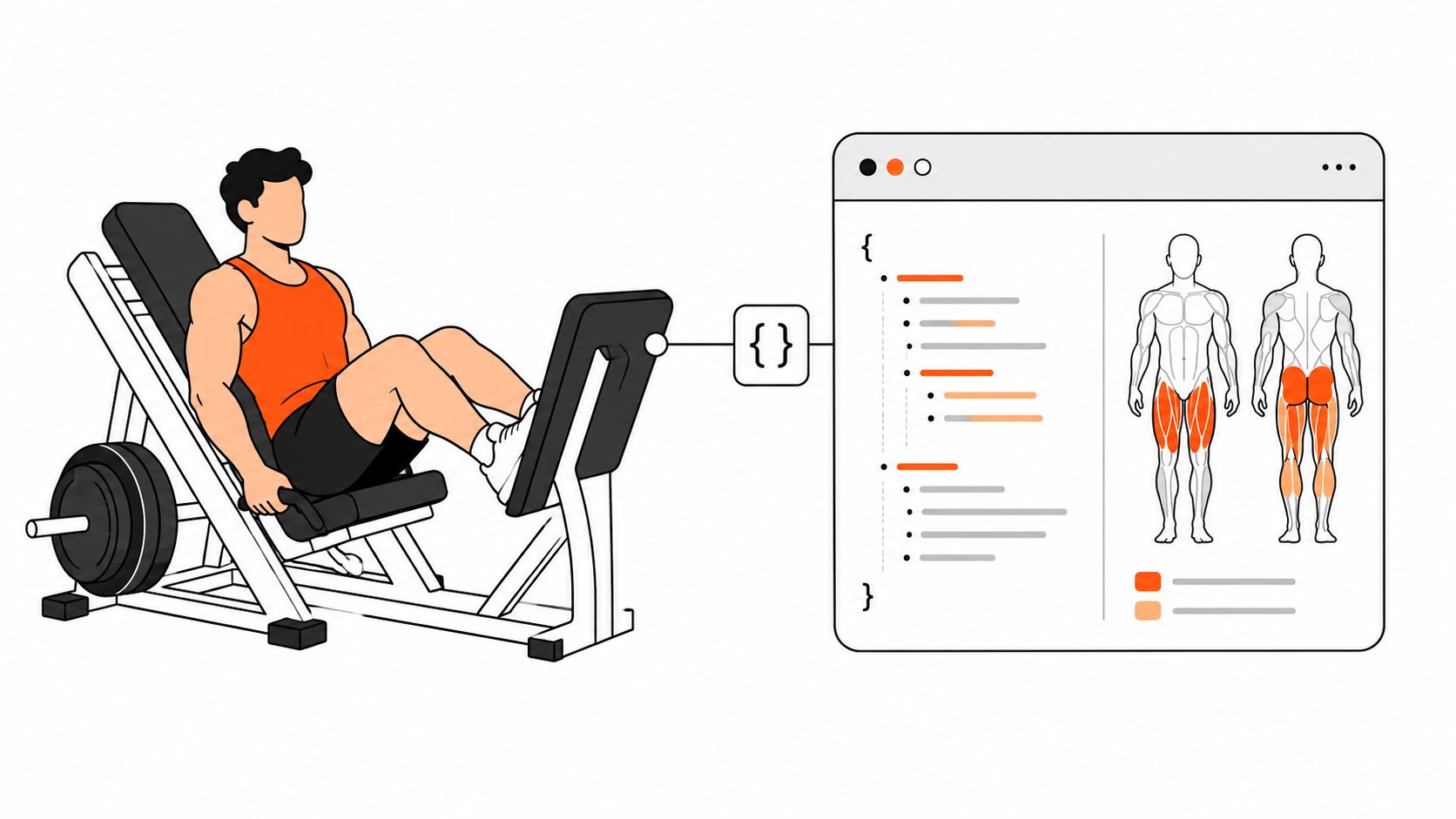
Exercise API is an open database + API of gym exercises. Each exercise comes with:
- Name in Spanish and English.
- Muscle group and equipment type.
- Primary and secondary muscles.
- Step-by-step instructions in both languages.
- Male and female illustrations (two frames: start and end of the movement).
- SVG muscle map, with male and female silhouettes, the primary muscle in orange and the secondary one in light orange.
There’s nothing to install or sign up for. You make a GET request to a URL and get JSON back. Or an image. That’s it.
The current catalog has 104 exercises (still growing), across 7 groups (Chest, Back, Shoulders, Arms, Legs, Core, and Cardio), with 15 muscles and 6 equipment types.
- Web / demo: marcmayol.com/exercise-api
- Documentation: marcmayol.com/exercise-api/docs.html
The design decision that makes it so simple: everything is static
Here’s the part I most enjoy telling. Exercise API has no server.
There’s no backend running, no database to maintain, no endpoint that falls over at three in the morning. It’s all static files served by GitHub Pages’ CDN. Each “endpoint” is literally a JSON file living at a specific path.
That has some very nice consequences:
- No authentication: no keys, no tokens.
- No limits: there’s no rate limiting because there’s no server to protect.
- Open CORS (
*): you can consume it straight from the browser, no proxy needed. - Fast and cheap to maintain: GitHub’s CDN does the heavy lifting and it doesn’t cost me a cent.
The “trick” is that a well-designed REST API, for data that’s read a lot and written rarely, doesn’t need to run code on every request. If you can precompute every response, a CDN gives you infinite scalability for free. And an exercise catalog is exactly that: constantly queried, changed only once in a while.
Versioning goes through a /v1/ prefix. If I ever have to break compatibility, it’ll live under /v2/ and /v1/ will keep working for anyone already using it.
The endpoints
Since it’s all static, the list of endpoints is the list of files:
| Endpoint | What it returns |
|---|---|
GET /v1/exercises.json | Index of all exercises (summarized) |
GET /v1/exercises/{slug}.json | Full card for one exercise |
GET /v1/dataset.json | Everything in one file (cards + taxonomies) |
GET /v1/groups.json | Groups + count |
GET /v1/muscles.json | Muscle taxonomy |
GET /v1/equipment.json | Equipment types + count |
GET /v1/by-group/{group}.json | Exercises by group |
GET /v1/by-muscle/{muscle}.json | Exercises by muscle |
GET /v1/by-equipment/{type}.json | Exercises by equipment |
GET /images/{slug}-m.jpg · -f.jpg | Illustration (male / female) |
GET /muscle-maps/{slug}.svg · -f.svg | Muscle map (male / female) |
GET /exercise-api-dataset.zip | Everything in a ZIP (dataset + images + maps) |
Since these are files, asking for something that doesn’t exist returns an honest HTTP 404. No surprises.
A full card looks like this:
{
  "slug": "leg-press",
  "name":  { "es": "Prensa de piernas", "en": "Leg press" },
  "group": { "id": "legs", "es": "Piernas", "en": "Legs" },
  "equipment": { "id": "machine", "es": "Máquina", "en": "Machine" },
  "primaryMuscles":   [ { "id": "quadriceps", "es": "Cuádriceps", "en": "Quadriceps" } ],
  "secondaryMuscles": [ { "id": "gluteal", "es": "Glúteo", "en": "Glutes" } ],
  "instructions": { "es": [ "..." ], "en": [ "..." ] },
  "images": { "male": ".../leg-press-m.jpg", "female": ".../leg-press-f.jpg" },
  "muscleMaps": { "male": ".../leg-press.svg", "female": ".../leg-press-f.svg" }
}
How it’s built: one seed and a pipeline
Behind the API’s simplicity there’s a piece I had a lot of fun building: the generator.
Everything starts from a single file, exercises_seed.json, which is the source of truth. One entry per exercise: slug, names, group, equipment, and muscles. From there, a Python script (build_api.py) does all the magic:
- Writes the instructions in Spanish and English using an OpenAI model, and caches them so I don’t pay twice for what’s already generated.
- Draws the SVG muscle maps from the paths of an open source library (react-native-body-highlighter, MIT), coloring the primary and secondary muscles, in both male and female versions.
- Copies the illustrations, which are generated separately with a text-to-image model following a fixed canonical style (flat vector, white background, two frames of the movement) so all images match each other.
- Emits every JSON file: the index, the cards, the taxonomies, and the cross-references by group, muscle, and equipment.
Adding a new exercise is basically: write its entry in the seed, generate its two images, run the generator, and commit. GitHub Pages publishes on its own. I like working this way because the data lives in one place and everything else is derived from it. No editing twenty files by hand and praying you didn’t miss one.
License and credits
The API is free to use, including commercially, with a single condition: credit the author and link back to the repository. It’s an MIT-style license with attribution.
And since the muscle maps are built from the vector paths of react-native-body-highlighter (© 2022 ELABBASSI Hicham, MIT), its license notice travels inside the repo and the ZIP. Giving credit to someone who saved you weeks of work isn’t just a legal duty: it’s the bare minimum.
What’s next
The plan is to keep growing the catalog in batches —there are always exercises missing— and to polish a couple of details in the muscle taxonomy. But the important part is already there: an open, free, bilingual, friction-free exercise database that anyone can use to build their fitness app, their workout tracker, or whatever they come up with.
If you build something with it, I’d love to see it. And if you’re missing an exercise, tell me: it’s probably already on the to-do list.