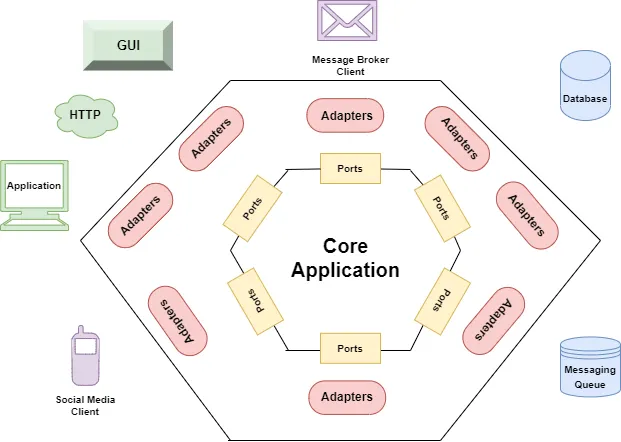
When we talk about systems with language models (LLMs), we almost always focus the conversation on the model: how powerful it is, how many parameters it has, how it’s trained, or how much it costs to use. But there’s something equally important that we often overlook: the architecture that surrounds it. Because a good model with bad architecture can end up being a maintenance nightmare. And that’s where hexagonal architecture, also known as Ports & Adapters, comes in.
What is Hexagonal Architecture?
Hexagonal architecture was proposed by Alistair Cockburn with a simple yet powerful idea: an application should not depend directly on its environment (databases, APIs, interfaces, etc.), but rather communicate with it through well-defined ports and interfaces. The goal is to isolate the system’s core logic, the part that truly provides value, from any technical or infrastructure details surrounding it. In other words: your application should remain alive even if you change everything around it.
Why a Hexagon?
The hexagon is merely a visual metaphor. Cockburn chose it because it allows multiple entry and exit points to the core of the application. Each side of the hexagon represents a port, and each port connects to adapters that translate between the external and internal worlds.
This way, the core remains clean, stable, and protected from technological changes.
Main Components
To understand how it works, let’s look at its three basic elements:
1. Core (Domain)
It’s the heart of the system. This is where the business logic lives or, in the case of AI, the logic of the agent or cognitive flow. The core knows nothing about APIs, databases, or models. It only defines what needs to be done and how it’s organized internally.
2. Ports
These are abstract interfaces that define how the core communicates with the outside world. They can be:
- Input ports: what the application receives (a request, event, message…).
- Output ports: what the application needs to do externally (store data, invoke a model, call a service).
3. Adapters
These are the concrete implementations that act as “translators” between the system’s domain and the external technology, connecting those ports to the real world. For example:
- An HTTP controller that receives a request.
- A client that sends prompts to the OpenAI API.
- A connector to a vector database.
General Advantages of Hexagonal Architecture
-
Total Isolation: The core doesn’t depend on any specific technology. You can change the database, API, or provider without touching the internal logic.
-
Easy Testing: Thanks to the ports, you can replace real adapters with mock ones. This allows you to test your application’s logic without spending tokens or relying on a real connection.
-
Frictionless Evolution: If a new tool appears tomorrow, all you need to do is create a new adapter. The rest of the system remains unaware and unaffected.
-
Cleaner Code: Each part has a clear responsibility. This reduces coupling, improves maintainability, and makes team collaboration easier.
-
Resistance to Change: Technologies evolve constantly, but your domain doesn’t. Hexagonal architecture protects what truly matters, the core of your solution, allowing you to adopt new technologies comfortably and evolve alongside your system.
Advantages of Hexagonal Architecture in LLM-Based Systems
When we apply this pattern to the world of generative artificial intelligence, its advantages become even more apparent.
-
Decoupling the Model from the Application: The core doesn’t need to know whether you’re using GPT-4, Claude, Mistral, or a local model. It only defines a single port: “Generate text.” Each model is just a different adapter implementing that interface. Want to switch from OpenAI to another provider? Simply change the adapter, the rest of your application stays the same.
-
Simpler Testing: You can create fake adapters that simulate model responses. This lets you test your logic without consuming tokens or depending on the network.
-
Modularity in AI Flows: LLM-based systems often include many components, context retrieval, generation, reasoning, memory, API integration, and more. Each of these modules can be represented as a port with its own adapters, enabling more organized and robust systems.
-
Resilience and Control: If one model’s adapter fails, another can act as a backup. You can also track metrics, costs, and response times without touching the core.
-
Safe Evolution: As models evolve or improve, you can update the adapters without altering the system’s heart. This makes your architecture sustainable over time.
Conclusion
Hexagonal architecture isn’t just a nice way to draw diagrams; it’s a design philosophy that protects the essence of your system from external chaos. In a world where language models evolve daily, this pattern allows you to build solutions that are more flexible, scalable, and durable.
Applying it to AI projects isn’t a trend, it’s an investment in clarity, stability, and the future.